Going Zero to One : A Wanderer’s Notes on Product Research

Going Zero to One : A Wanderer’s Notes on Product Research

When was the last time you reached out to a stranger on LinkedIn, hoping to tap into their understanding of an interesting new market? If you’re like many product managers, grown accustomed to leaning on existing customers or internal subject matter experts, that thought just sent a chill down your spine!

But the most interesting new ideas can’t be found within your office walls, they’re out there in the wooly wild of emerging markets.

Developing a new product in an emerging or rapidly-changing market – going zero to one – is dramatically different from building out a mature product or creating something new in a well-understood space.  While the core product management skills of research and requirement design are shared in both situations, the importance of open-ended questions, the willingness to discard hypotheses, and to live in uncertainty while constantly experimenting can be so different as to paralyze even the best product manager.

To understand how inventing a zero-to-one product in an emerging space is different from developing for a well-understood market, let’s first talk about repeatability.  

Repeatability is what turns a product into a business. The ability to sell what you’ve built to 80% of the prospects you can attract, using only your set of sales playbooks is the catalyst that enables infusion of capital to predictably deliver measured growth.

Late-stage startup development goals – operational mastery of your funnel metrics, pipeline efficiency, customer acquisition cost, cost of goods sold and net retention – are all gated on repeatability.  It doesn’t make any sense to talk payback period, unit economics, or EBITA until you have repeatability.

Developing a new product in an emerging or rapidly-changing market – going zero to one – is dramatically different from building out a mature product or creating something new in a well-understood space.

So what’s the relationship between defining your product strategy in your market and achieving repeatability? It’s a sequential relationship, where building and executing your product strategy delivers product-market fit and enables you to start developing sales repeatability, and it is foundational in the lifecycle of a company, particularly in its early stages of growth.

Let’s define our terms.

1. Product-Market Fit (PMF): This refers to the stage where a company has validated that its product or service satisfies a strong demand in a specific target market. It’s the point where customers are not only willing to buy the product but are enthusiastic about it, leading to strong customer retention and organic growth through word-of-mouth referrals. Achieving PMF indicates that the product solves a real problem for a significant portion of the market.

2. Sales Repeatability: Once PMF is established, the next challenge is to build a repeatable and scalable sales process. Sales repeatability means that a company can predictably generate revenue by applying the same sales strategies, tactics, and processes across multiple customers. This involves creating consistent sales methodologies, refining the buyer journey, and ensuring that sales teams can replicate success without needing to reinvent the process for every new lead.

The key relationship attributes between PMF and Sales repeatability are dependency, efficiency, and scaling:

Dependency: Product-market fit is a prerequisite for achieving sales repeatability. Without a clear understanding that the product satisfies a market need, any sales process will likely be inconsistent or fail to scale. PMF ensures that there is demand; sales repeatability ensures that this demand can be systematically addressed and monetized.

Efficiency: Once PMF is attained, it becomes much easier to develop a sales strategy because the value proposition is clear, and customer feedback has validated the product’s relevance. The sales team can then focus on refining the messaging, targeting, and techniques to reach similar customers in a repeatable manner.

Scaling: When both PMF and sales repeatability are present, the company is in a strong position to scale. PMF ensures the product is wanted, and sales repeatability provides the mechanism to efficiently capture that demand on a larger scale, driving revenue growth.

To sum this up: product-market fit is about proving the product’s value, while sales repeatability is about scaling that value in a structured and predictable way.

PMF is essential to success for any product endeavor. This is no different when you’re looking for success in a new or rapidly-changing market – but the difficulty is far higher. Without an established customer base to survey, existing players to study, or even a well-defined market for analysts to report on, first-principles research and the hard work of developing relevant primary sources is a requirement

And a little flailing around on LinkedIn isn’t going to cut it – sorry folks, no shortcuts here!

So here’s a structured yet adaptable approach for developing a new product thesis in a poorly-defined market, given the uncertainties and complexities involved. Let’s outline the key elements for this process:


1. Gather Your Market Insights

Lean on early pioneers: Establish close connections with early adopters in your target space, allowing their feedback to guide initial directions. Engage with them through multiple rounds of discovery to refine your understanding and uncover questions you didn’t initially know to ask.  Invest in building quick-and-dirty concepts, experiments, and mockups and orient your feedback processes to suss out the problems that are interesting to solve rather than the specifics of a given solution.

Broaden your research horizon: Recognize the limitations of relying solely on existing customers, as it can create a biased view of the market. To build a balanced picture, expand research to potential customers who aren’t engaged yet. Spend some of your demand generation resources driving traffic to your research programs, and engage with as many relevant people as possible, even if they’re not immediately actionable prospects.

And leverage the discussions that are happening outside of your own activities! Participate in community meetups, in online forums like StackOverflow and Reddit discussions, and at industry events and trade shows. Even industry blog comments can give a broader view of latent needs.  Throughout this, be rigorous in your data collection – keep good notes, leverage AI transcription of meetings, link back to discussions, and constantly re-examine both your insights and the audience they’re derived from. 

Finally, consider contributions you can make and experiments you can run in your target market, even (maybe especially) if they’re not a product you intend to sell – engaging with a community is much more meaningful if you’re offering to contribute, not just learn.

Scale your research efforts: As the need for quantitative and qualitative supporting data grows, consider formal survey research or UX-focused analysis to capture wider market insights systematically.  Forums and conferences are great for conversations, but those anecdotes are not easily subjected to rigorous analysis.

2. Define Your Product Direction

Don’t be afraid to use intuitive decision-making: Base your product’s direction on a combination of intuitive understanding from research and technical discussions with engineering partners. This ensures that the solution aligns both with market needs and technical feasibility. Your target market isn’t going to be good at describing its ideal solution – you’ll need to use your understanding of the problem to invent interesting products, but you also need to stay grounded in technical reality.

Evaluate risks: Each new product involves distinct risks:

     – Customer Relevance: Validate that the product concept resonates with a potential customer base. Mitigate the risk of building an exciting solution for a problem that isn’t important through interviews grounded in a prospective purchase.

     – Feasibility of New Concepts: For novel or untested ideas, ensure that the team has clarity on the concept, expected outcomes, and technical capability to deliver.

     – Resource and Timeline Management: Establish realistic timelines and resources, balancing the anticipated product development time against available bandwidth.

Set tactical milestones: To mitigate the risk of sinking too many resources into an impractical or unattractive product, set measurable milestones, such as early customer pilots, technological proofs-of-concept, or small wins with initial investments that confirm feasibility and value.

3. Set Priorities and Milestones

Establish early momentum: Resist the temptation to complete your product before sending it out into the world – you don’t need a complete solution to get feedback, just the kernel of value that activates your audience. Prioritize deliverables that establish a sense of early progress. Bring together cross-functional teams (product, engineering, design) to align on immediate goals that demonstrate velocity and validate the product concept. Nothing will energize (and validate!) your early work better than getting an early concept into the hands of real users.

Prioritize your roadmap through your vision: A clear north star vision is essential for aligning the roadmap. Establish guiding principles and strategic trade-offs that provide clarity for every roadmap discussion. This shared vision acts as the decision-making anchor and ensures that product decisions stay on course.

Plan collaboratively: Develop the roadmap in consultation with engineering, UX, and business teams:

     – Product: Focus on customer and business value.

     – UX: Ensure each milestone delivers a cohesive user journey.

     – Engineering: Evaluate technical risks, confidence in deliverables, and realistic development timelines.

Communicate with your stakeholders: Regularly present the roadmap to leadership, ensuring alignment. When sharing externally, maintain a consistent narrative that conveys how the roadmap leads to the desired outcomes for customers and stakeholders.

4. Test and Validate

Use early feedback loops: Prioritize early and continuous feedback as a principle. Test hypotheses with users from the start using informal mock-ups, clickable prototypes, or API demonstrations. This allows for rapid learning and iteration, well before reaching a beta stage.

Invest in user behavior analysis: Observe user interactions closely—monitor what users do, identify pain points early, and be ready to adjust based on their success or difficulties.

Manage expectations: As you gather early feedback, control the narrative to avoid misinterpretations or unmet expectations among stakeholders, especially when testing is in ideation stages. A vocal minority can easily kill a seedling product, even over a misunderstanding.

5. Handle Inbound Requests

   – Align using your strategy: Treat the roadmap as a living document while maintaining a consistent vision and strategy. Evaluate each inbound request on whether it aligns with this strategic vision, determining if it’s simply a premature idea or if it diverges from strategic priorities altogether.

   – Balance customer influence: When handling requests from key customers, weigh their business impact and the potential need for custom work. Consider the future trade-offs, like tech debt, that may arise if requests require substantial customization.

6. Manage Technical Debt

   – Understand Long-Term Impact: As a product manager, cultivate awareness of the technical debt implications of certain decisions, particularly custom requests. Often, early decisions have long-term impact on your ability to sustain development. Evaluate if taking on tech debt for one customer aligns with the broader roadmap and, if so, plan for how and when to address it in the future.


Tying it all together

In essence, building a new product for an unclear market involves a flexible approach grounded in deep customer understanding, iterative testing, and a well-communicated strategy. Balancing these elements can help shape a viable product that resonates with a still-emerging market while remaining adaptable to new insights and challenges.

And developing your market and product hypotheses using the knowledge you’ll collect this way is your best shot at finding product / market fit and successful growth. Now get out there and get researching!

Don’t get trapped in a local maximum by a sales-led product.

Don’t get trapped in a local maximum by a sales-led product.

Does winning your next customer feel harder, when R&D ought to be making it easier?  If you’re like many startups, the root cause is your sales-led product development.

Being sales-led is a necessary step in the evolution of your business. You’ve burned through seed capital, proven the core technology works, and gained happy customers paying real money for value – but every win seems to come at the cost of “just a few little feature commitments…”

During early stages of growth, it’s common and even advisable to prioritize immediate customer needs over long-term product strategy. The focus is necessarily on landing the next logo, even if that means deferring your strategic vision – and let’s be honest, you aren’t totally clear yet about what your market actually looks like.

Plus, you need the feedback (not to mention the revenue!) – and without the crucible of actual customer implementations, that strategic roadmap is just a theory.

However, when this sales-driven mindset persists for too long, product/market fit gets further away, not closer. Building out your capabilities and compatibilities in the order your prospects arrived won’t help you be a better fit for the broader market – and when sales-driven feature work represents the majority of your engineering effort, your product risks becoming blurry and incoherent.

For example, imagine you’ve built a product that queries relational databases. You can reach a lot of the market just by supporting postgres and MySQL, and most of the rest of it by supporting SQL server. A massive enterprise wants to become a customer, but they’re running Qbole. You’ll support Qbole for them, right? How hard can it be?

Suddenly, you’ve backed into supporting Hive, but your only test environment is this one customer – so your coverage is spotty, your documentation is full of exceptions, and you’re constantly worrying that your customer will upgrade and break your fragile integration. Oh, and now your account execs tell prospects “Of course we support Qbole!” and your sales engineers keep making that face, you know the one.

A little later, your query product is getting further into the business side and a prospect asks if you can do more than query data – can you write changes back to the database? That would be really convenient for this one operational use case they’ve got, where sales can correct deal forecasts in-situ. Sure, this breaks a core tenet of analytics systems (modifying data outside the transactional system) but it would open up a new use case – do you want to go there? Will you have to, in order to land this client? How much support are you going to put into this new product direction?

The examples are endless. If you’ve been in product for any length of time, you have your own story you’re thinking of right now. In aggregate, here’s what typically happens:

1. Inconsistent Feature Maturity: Some features are highly robust, capable of handling a variety of scenarios, while others remain shallow, lacking the depth of support expected by users.

2. Limited Use Case Portability: Features built for specific customers don’t work reliably in other scenarios, or aren’t relevant to the majority of new prospects, making qualification harder and cases studies less impactful.

3. Pre-Sales Challenges: Your pre-sales engineers struggle to show the product can support the needs of new prospects, or constantly hack around shortcomings in POCs. The features you developed in response to customer requests add to the complexity of your product but provide little competitive value or differentiation.

4. Technical Debt and Architectural Weaknesses: Least-cost feature implementations often lead to negative architectural tradeoffs, resulting in inter-module dependencies and technical debt. Over time, this slows down development velocity and blocks innovation.

5. Market Confusion: As your product becomes a patchwork of features with no clear overarching vision, your go-to-market teams will find it increasingly difficult to articulate who should use your product, what problems it solves, or what use cases it excels at.

6. Sales Bottlenecks: Your sales velocity is constrained by your engineering team’s capacity to develop new features. You will find yourself unable to close more deals simply because you lack the resources to meet the feature demands of new prospects.

7. Diminishing Return on Equity: As too much of your R&D budget is spent on serving the narrow needs of a few customers, your business begins to resemble a professional services shop rather than an independent software vendor. This erodes return on equity and stunts growth.

The Cure: Transitioning to Market-Driven Thinking

To avoid these pitfalls, a shift towards market-driven thinking is essential. Here’s how to do it:

Focus on Market Segmentation: For each new feature or capability, consider what other customers you could land with the same implementation. Assess whether this segment is addressable by your current technology and go-to-market team before proceeding.

Develop a Differentiation Thesis: Create a clear thesis on why a prospect should choose your product over building a solution themselves or opting for a competitor. Identify your core competencies and competitive differentiators, and build features that leverage and enhance these strengths.

Demand a Business Case for New Investments: Insist on a thorough business case from your product managers for each new product investment. Determine who will buy it, how you will market it, and whether it will attract new customers or expand existing ones. Incorporate both go-to-market (GTM) and technical reviews in your evaluation process.

Practice Saying ‘No’ to Feature Requests: Feature requests tied to specific deals should be the exception, not the rule. This is crucial whether you’re selling to SMBs, midmarket, or enterprise customers. If every deal requires new development work, it becomes impossible to maintain, let alone improve, your margins while scaling.

Allocate Limited Resources for Deal-Driven Work: Reserve no more than 10% of your development resources for customer-driven features, and assign a dedicated team to this category of work. This allows you to accommodate some customer-specific needs without derailing your overall product strategy. Ensure that the scope of these projects remains limited to prevent a single customer dominating this pipeline.

Separate Product Management from Engineering: In sales-driven companies, product management often reports to Eng leadership, and serves primarily as an intermediary between customers and developers. However, for market analysis and product vision to thrive, product management must be independent of engineering leadership, so that the natural tension between a market vision and a technical vision can lead to an efficient product.

Eliminate One-Off Features and Transition Oddball Customers: Where possible, shut down one-off features or use cases that were developed to secure early deals but have little appeal in the broader market. This may not be feasible for capabilities used by actively growing customers, but reducing unnecessary complexity will streamline your product. And wherever possible, help poor-fit or off-strategy customers transition to other solutions, as their revenue rarely makes up for the opportunity cost of servicing their needs.

Indicators of a Successful Transition

As you shift from sales-driven to market-driven thinking, several positive changes should become apparent:

Increased Customer Independence: A growing number of new customers successfully implement your solution with minimal need for new features or extensive technical support.

Organic Lead Generation: New business wins with prospects that came inbound, rather than in response to outbound sales activities.

Homogeneous Customer Profiles: Your prospects increasingly resemble each other, sharing similar architectures, platforms, technologies, and challenges.

Improved Roadmap Execution: You’ll deliver more of your strategic product roadmap on time, with fewer disruptions to your backlog.

Clearer Value Proposition: The problems your product solves become increasingly obvious and clear, making it easier to communicate your value proposition to potential customers.

Strategic Sales Conversations: Your sales team spends more time discussing the business impact of your solution with decision-makers, and less time delving into technical details with implementation teams. Sales engineers can service more accounts at a time, and focus primarily on big, high-value deals.

Timing is Everything

Timing your transition from a sales-driven to a market-driven approach is critical for the healthy growth of B2B products. Shift too early, and you risk building features without sufficient customer feedback. Wait too long, and your product will morph into a disjointed, incoherent platform. However, with the right timing, you can capitalize on early successes and propel your product toward a strong product-market fit, ensuring long-term success and scalability.

Flow state

Flow state

I really love coffee. My favorite thing in hotels is the ubiquitous little pod-driven espresso makers that let me enjoy a cup before I’m actually awake. Despite owning a “real” espresso machine, I’ve learned a lot from surviving international travel: I keep a Nespresso CitiZ coffeemaker next to my bed.

I adore this machine. It’s shiny chrome, an exact duplicate of one I used years ago in the penthouse of a gorgeous parisian hotel decorated in demure, luxurious furniture and a view of the Eiffel tower, and it makes perfectly delightful coffee using recyclable aluminum pods.

It’s made thousands of cups of coffee since I bought the thing in 2014. Long out of warranty, Nespresso has disavowed it and won’t provide service or sell me parts, but I have had little trouble with it over a decade, which I consider an exceptional lifespan for a consumer device.

Recently though, it started to cry for help. What once had been full cups of coffee now came out as a bare ounce of tepid brown stuff, with both the Espresso and Lungo buttons producing identical results. 

I can’t tell you how heartbroken I felt. This is a cherished little machine! I didn’t want it to be broken. Instantly I swore to fix whatever was ailing it.

As an experienced engineer, I knew exactly what to do: I googled “nespresso citiz not brewing full cup”.  Google’s dubious AI Search summarized the advice of a dozen sketchy fix-it sites: try reprogramming the cup volume (that’s a thing my CitiZ can do, set a user-defined pour), or try a hard reset by holding down the Lungo button while powering on (sensible, I suppose) or even, hey, check to make sure there’s enough water in the tank (lol).

Button-mashing didn’t work – unsurprisingly, as if it was just the volume config, the coffee probably wouldn’t be coming out tepid. A few reddit posts hinted at hard water scale causing this exact problem, and that descaling fixes it – it’s insights like these that has AI companies begging Reddit to take their money for a training-data license – but while I sidestepped the DIY vinegar (too corrosive for the aluminum thermoblock!) and used the pricey Nespresso descaling solution, it didn’t help one bit.

However, a clue! – just like the coffee mode, the machine wouldn’t run a full tank of descaler through either, but instead dispensed a measured ½ cup before halting. I could get a tank through by repeatedly triggering the cycle, but that’s not expected behavior – and it dispensed a precise, consistent amount each time. 

That seemed like some kind of system behavior – failure or otherwise – rather than a faltering pump or a clogged pipe.  Software behaves in repeatable failure modes like this far more often than worn-out moving parts.

The CitiZ isn’t really that complicated inside. Despite using extremely sophisticated injection-molded components, it’s mechanically simple: there’s a pump, an inline thermoblock, a brewing unit, a flow meter, and a logic board. That’s it.  Given that the mechanicals worked, but the system was halting early, I guessed it had to be either the logic board or the flow meter.  And on the principle of do the easiest thing first, I pulled out the little flow meter.

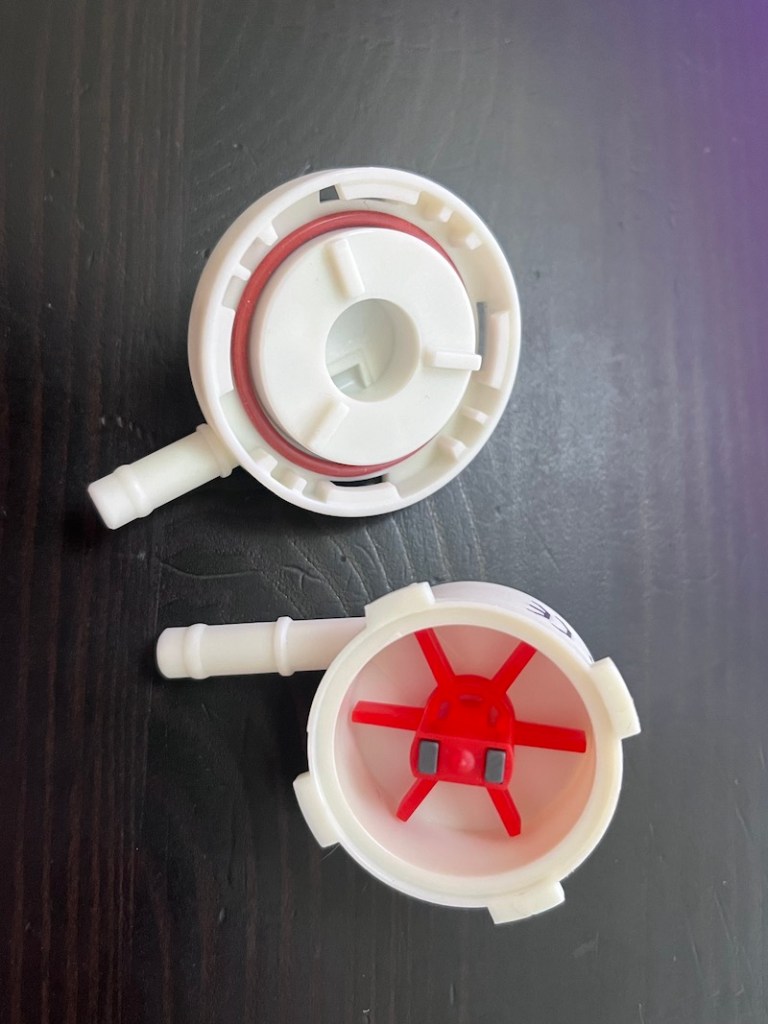
It’s so cute! The three pins told me it’s a Hall-effect sensor, with a little spinny bit and a magnet inside. And it didn’t seem user-serviceable, so a little searching revealed that this is actually a jellybean part that is in all sorts of machinery, comes in multiple variants and is available on eBay as a spare part for several brands of coffeemaker.

Mine didn’t seem to do anything when water flowed through the inlet, like it was stuck open. Theory: the logic board, getting no pulses from the meter, probably cuts off the pump after a timeout period to avoid burning it out, and similarly throttles down the thermoblock to prevent overheating. (Maybe? I’m purely guessing here.)

Oh, and the flow meter is actually totally field-serviceable. I didn’t even think to try this until I got the replacement in the mail, but the top and bottom just twist apart, revealing its one moving piece – a water wheel with magnets, forming the element of a Hall-effect sensor. 

I think mine just got a little debris in the spindle and stopped freely spinning. I installed the new one, but I kept the original as a spare – you never know, right?

So now I have easy coffee again. Just thought I’d share, since nowhere I looked (including iFixit, Reddit, even a gray-market copy of the internal Nespresso service manual) talked about the flowmeter or this failure condition – and this is exactly the kind of little around-the-house fix-it thing that I love to do and I wanted to send the joy of it out to you all.

How to get a job in Product Management

How to get a job in Product Management

Wherever product managers gather, by far the most common question I get is “how do I become a product manager?”  No surprise there – product management is a highly visible, intensely exciting, and enormously creative job – but it’s not the kind of job you can land straight out of school, through a coding camp, or via an executive MBA program.

Still, people find their way to product management from a diverse set of backgrounds, and as a veteran of the industry who has hired many, many PMs, I’d like to demystify the path to product.

So, straight from a senior leader in product: here’s how to get a job as a product manager.


1. Master Your Current Role

No one starts out as a product manager. It’s a role that comes after you’ve developed expertise in another area of product delivery. Whether you’re in business strategy, marketing, support, customer success, development, or testing, your current domain will form the first pillar of competency upon which your product management career will be built. The key is to master what you’re doing now. This not only builds your visibility organizationally but also provides you with a core of experiences you can lean on as you engage with other functions of the business.

Pro tip: While mastering your current role, it’s also essential to gain as much exposure to customers as possible. Product management is a customer-centric role, and the more you understand your customers’ needs, pain points, and behavior, the better equipped you’ll be to make decisions that will drive product success. Seek opportunities to interact with customers directly, whether through support calls, user interviews, or market research. This firsthand experience – and the customer anecdotes! – will be invaluable as you make the case for your move into product management.

2. Understand your Market

One of the critical shifts in moving to product management is transitioning from understanding individual customers to understanding the broader market. 

Many successful product managers got started by going deep on specific customer problems, capturing the critical nuance that a surface overview would miss. (This is why many product managers have a sales engineering background—they’re professionally competent at understanding and articulating customer needs.)

However, to be an effective product manager, you need to go beyond individual customer problems and think about the market as a whole. What are the common pain points across different customer segments? What gaps exist in the market that your product can fill? Understanding the market means seeing the bigger picture, anticipating the needs of potential customers, and articulating that market understanding in a clear and consistent manner.

Product managers aren’t the voice of the customer; they are the voice of the market. You’ll be advocating for the needs of communities of customers and ensuring that the product serves the broader market effectively. This requires getting away from over-reliance on your knowledge of a specific customer, and instead developing a broad-based understanding that is backed up by data and market analysis.

Start talking about the parts of your market you can reach today, the ones you can reach tomorrow with some new capabilities, and your estimates of the size of the populations you aim to address – this will show that you’re working with a growth mindset.

3. Focus on the Future, Not Just the Present

It’s easy to point out what’s not working in a product—missing features, bugs, usability issues—but that’s not where the true value of a product manager lies. The real challenge is identifying the right next steps for product development. What should the team build next, and why?

As a product manager, your job will be to prioritize the most critical features that will drive the product forward, and to say no to all the tempting features that aren’t strategically relevant. 

This involves understanding the product’s long-term vision and aligning it with current market needs. It’s about making tough decisions, often with incomplete information, and justifying those decisions with clear reasoning and data. Being able to articulate why one particular feature should be built next over all the others is a key skill that separates great product managers from the rest, and demonstrating that skill will put you on the product manager shortlist.

4. Use Data to Back Up Your Decisions

Storytelling is a powerful tool in product management, but it’s even more compelling when backed by data. While anecdotes and personal experiences can help illustrate a point, quantitative data provides the evidence needed to make a convincing case. Whether you’re estimating the potential market size for a new feature or analyzing user behavior, data is your ally.

However, you will rarely be able to get all the data you want, or as much precision as you’d like. Realistically, estimates and extrapolations are usually sufficient to guide decision-making, as long as you’re transparent about the assumptions and guesswork involved. The goal is to use data to support your ideas and show that your decisions are grounded in reality, not just intuition.  

Demonstrate that you bring the data to the discussion, that you’re transparent about what you know and what you’re extrapolating, and you’ll quickly garner the trust of those around you.

5. Socialize Your Ideas and Seek Feedback

Product management is not a solitary role. It requires collaboration and partnership with multiple stakeholders across the business. One of the best ways to ensure your ideas gain traction is to socialize them early and often. Share your thoughts with colleagues, seek feedback, and listen to different perspectives. This not only helps refine your ideas but also builds support across the organization.

Getting feedback is particularly important because it helps you see potential blind spots and improves the quality of your decision-making. Moreover, when you have the backing of other teams, it’s easier to push your ideas through and get the necessary resources to bring them to life.  

Work your internal network, expand it where possible, and when it comes time to make an internal transfer into the PM organization, your name is likely to come up from multiple corners.

6. Be Bold in Advocating for Your Ideas

Product management is not for the timid. If you have a vision or a strong belief in a particular direction for the product, you need to make your case and be willing to stand by it. This doesn’t mean being inflexible, but rather being confident in your ideas and advocating for them assertively.

Being bold also means taking calculated risks. Product management involves making decisions with imperfect information, and sometimes you’ll need to take a leap of faith. The key is to have a well-thought-out rationale for your decisions and to be prepared to defend them.  

A reputation for ambitious moves will definitely get you noticed, if those moves are well-founded.

7. Know When to Let Go

Not every idea will gain traction, and as a product manager, you need to know when to let an idea go. It can be frustrating to see a concept you believe in not getting the support it needs, but persistence isn’t always the best approach. Executives and leaders are often aware of your ideas, even if they don’t immediately act on them.

If you’ve made your case and it’s clear that your idea isn’t going to move forward, it’s better to let it go and focus on your next concept. Patience is a critical trait in product management, and sometimes the best course of action is to wait for the right opportunity rather than pushing too hard.  

Demonstrate your ability to work professionally, to pick your battles, and to change your position based on new information, and you’ll be modeling the ideal product manager mindset for those around you.

8. Be Mostly Right

Finally, one of the most challenging aspects of product management is the need to be right most of the time. There’s a lot of guesswork involved, and every decision carries significant consequences. While it’s impossible to be right 100% of the time, great product managers have a knack for making the right calls more often than not.

This ability often comes from experience, intuition, and a deep understanding of both the market and the product. It’s about making informed decisions, learning from mistakes, and continuously improving your judgment.

However, it’s crucial not to confuse the need to be right with the need to be seen as right. Product management is about making the best decisions for the product and the company, not about ego or personal validation. The focus should always be on achieving the best outcomes, even if it means admitting when you’re wrong.


To sum this all up: becoming a product manager is a journey that involves mastering your current role, understanding the market, and demonstrating leadership potential for product development.

Landing a job in product means showing you can make data-driven decisions, socialize your ideas, be bold in your vision, and know when to let go. If you take these eight steps to heart, you will position yourself as a strong candidate for a product management role, and you’ll be on the fast-track for the next step in your career!

An honest product manager is a ruthless one

An honest product manager is a ruthless one

Have you worked with someone who always stays late because “there’s just too much to do!” and they can’t seem to cram it all into the workday? For most people, it’s not hustle culture, it’s poor prioritization skills that leads to the never-ending in-pile. 

Great product managers never suffer from this problem – not because their workload is more manageable, but because they know the pile is never-ending, and thus have developed ruthlessly efficient prioritization skills.

Let’s acknowledge the truth of feature development – it’s not all going to get done, not ever (and it doesn’t need to!)  Once that reality sinks in, we can start having real conversations about what’s most important to do next, and what can go into the ‘nope’ pile.

It’s important to have a ‘nope’ pile, by the way – backlogs with a ‘future’ category full of half-justified features help no one, and erode the trust in the honesty of product managers. Either put it on the roadmap, or cut it – that’s the core of ruthless prioritization.

Ruthless prioritization is a crucial skill for product managers, helping them handle the complexities of product development and ensuring that the most important tasks get done efficiently. With limited time and resources, being able to figure out what needs immediate attention versus what can wait is essential. This skill isn’t just about making tough choices; it’s about making the right choices that align with the product and company’s overall goals and vision.

First off, ruthless prioritization helps manage limited resources effectively. In any product development cycle, resources like time, money, and people are finite. A product manager who prioritizes well can allocate these resources to tasks that offer the highest return on investment. This means focusing on features or improvements that will have the biggest impact on the product’s success, whether that’s enhancing user satisfaction, increasing market share, or driving revenue growth. By prioritizing efficiently, a product manager ensures that the team isn’t spread too thin across too many projects, which can dilute their impact and lead to burnout.

Second, ruthless prioritization helps maintain strategic focus. At the pace of modern product development, it’s easy to get distracted by the latest hype cycle or the loudest customer requests. However, not all ideas and demands fit with the product’s strategic goals. A product manager must evaluate each request and idea against the company’s long-term vision and objectives. This requires a clear understanding of what the product aims to achieve and the discipline to say no to initiatives that don’t support this vision. By doing so, the product manager keeps the team focused on the core objectives, ensuring their efforts are driving the product in the right direction.

Additionally, ruthless prioritization leads to better decision-making and accountability. In a role where numerous decisions need to be made daily, having a solid prioritization framework can streamline the decision-making process. It allows the product manager to make informed decisions quickly, based on a clear set of criteria that consider impact, feasibility, and alignment with strategic goals. This not only speeds up the process but also provides a clear rationale for why certain tasks are prioritized over others. This transparency is crucial for maintaining team morale and trust, as it ensures everyone understands the reasoning behind decisions and feels confident that their efforts are contributing to the most important goals.

And let’s not forget, prioritization is essential for delivering value to customers. In a competitive market, the ability to quickly respond to customer needs and deliver valuable features can be a significant differentiator. By ruthlessly prioritizing tasks that enhance the user experience and address key pain points, a product manager can ensure that the product remains relevant and competitive. This customer-centric approach not only drives customer satisfaction and loyalty but also positions the product as a leader in the market. And while a specific customer may not thank you for deferring their latest feature request, they’ll stick with you if your product decisions deliver value.

Lastly, ruthless prioritization is key in managing stakeholder expectations. Product managers often juggle the demands and expectations of various stakeholders, including executives, customers, and team members. By clearly communicating the priorities and the rationale behind them, a product manager can manage these expectations effectively, ensuring that stakeholders understand why certain tasks are prioritized and others are deferred. This helps build trust and fosters a collaborative environment where everyone is aligned toward the common goals.

So, as a product manager, don’t let the grindset push you into poor prioritization. Practice your decision-making skills continuously, and you’ll be amazed at how it enables effective resource management, maintains strategic focus, facilitates better decision-making, ensures value delivery to customers, and manages stakeholder expectations. 

In an ever-evolving and competitive landscape, the ability to prioritize ruthlessly sets successful product managers apart. It’s a skill that not only drives the success of the product but also defines the outcomes for your company.

The six stages of product management organizations

The six stages of product management organizations

As a career product leader, I love to geek out with other product people about how we build and re-build our teams. Organizational planning is important! For a long time, i’ve meant to write about the stages of organizational growth in product management, and for me, maturity models are a perfect fit for this kind of analysis.

I’ve had plenty of success in the past using a stage-based maturity model for describing data maturity, for design team evolution, and for infrastructure planning – so I applied that same strategy to the experience of my own companies and those of my peers in product management, and came up with a framework to help you understand where your team is at today, where you’re headed, and what kinds of challenges you must solve at each stage of growth.

I’ve shared this model around with other product leaders, and the consensus is that, at least for tech companies, product teams pretty much all follow this evolution:

  • Stage 0: Early-stage product teams, often led by founders, and how they manage product development, plus that all-important hiring of the first product manager.
  • Stage 1: The transition to sales-led feature development, the need for additional product managers, and the expanding role of product management in customer interactions.
  • Stage 2: The introduction of a VP of Product to formalize processes, create structured roadmaps, introduce a market-driven vision, and manage growing teams.
  • Stage 3: The differentiation of roles with Principal Product Managers focusing on market segments and efficient development strategies.
  • Stage 4: The emergence of the Chief Product Officer (CPO) who sets strategic direction and balances internal and external priorities while developing an organization that can operate at scale.
  • Stage 5: The adoption of a matrix structure for managing multiple product lines and routes to market, ensuring clear prioritization and efficient development across an increasingly-complex organization.

These stages will tell you when it’s time to hire that VP of Product, or if you are outgrowing the one you have and need a CPO, or why your founding product manager isn’t excited about running a team herself and is in danger of jumping ship. If you’ve read this far, I bet you’re already wondering where this model places your team. So let’s dig in!

Stage 0 – Zero or one product manager

Stage 0 organizations are exclusively early-stage, with a basic engineering organization (that may not yet even be split into teams). Feature development is engineering-led, and your core product (and customer understanding) is still being sketched out. 

At Stage 0, your product leader is typically a founder, often the CTO or CEO, who possesses a clear vision for the product. This vision is usually well-articulated because of all the pitching practice gained during fundraising. Although they have a deep understanding of the opportunity space, their grasp of the current market landscape may not be particularly mature.

As the initial product offering of a Stage 0 organization is developed, the detail-oriented work of story development, spec reviews, and sprint planning can quickly overwhelm the limited bandwidth available to a founder. Time pressure will overcome the desire to stay engaged with the engineering team.

During this stage, it is common to hire your first product manager. This individual should have either previous experience as a product manager or extensive domain expertise in your industry. (Bonus points if that individual has both, but don’t hold out for it.)  

It’s not uncommon for you to bring in a highly engaged early customer who has provided significant feedback. This person will have a strong understanding of your product and some market insight, and can usually overcome their lack of formal product experience by partnering closely with engineering to develop a compelling feature set.

At this stage, the primary relationship for product management is with engineering, with secondary interactions with presales and post-sale support. The main function of product management is to organize and prioritize work, and thus the main operational tool of product management is the backlog. User stories and functional specifications provide the primary means of communication with engineering.

Stage 1 – Two to four product managers

Stage 1 organizations are those that have hit on a successful combination of capabilities that meet the needs of a set of customers (but not necessarily a cohesive market). These organizations have an active sales motion, are refining and growing the core product to meet the needs of new customers, and are growing their engineering capacity to keep up. A shift from engineering-led to sales-led feature development is a hallmark of this stage.

At this stage, there is a clear need for more product management capacity to capture customer requirements, prioritize work, and partner with an engineering organization that is dividing into specialized teams. Additional product managers are brought in to handle the workload, and the Stage 0 PM tends to develop a ‘lead PM’ persona, whether formalized or de-facto.  

Most Stage 1 organizations are still operating under a founder-leader, and are flat, with individual contributors reporting directly to the founder. PMs in this stage are often ‘free-range’ – with limited personal bandwidth, a founder can’t provide a lot of coaching, and does not have the formal PM background required to train new hires. It’s not uncommon to send product managers in this stage to training companies like Pragmatic Marketing when founders cannot provide strong product mentorship themselves.

In Stage 1, product management’s web of relationships is expanding, with sales teams and revenue marketing making inroads to get help on customer calls and on positioning.  Engineering still consumes the majority of time, but product managers are taking more “feedback” calls and routinely engaging with post-sales support teams.

You find your organization has matured into Stage 1 sooner rather than later if product management is already spending meaningful time with your go to market organization, not just with sales. Product managers who are getting onto sales calls, supporting solution engineers, or operating as shadow product marketing will have less bandwidth, forcing growth earlier.

Product development continues to be planned through backlogs rather than formal roadmaps, with requirement summaries serving as containers for user stories, UX designs, and functional requirements, lacking business case and use case information.  PRDs aren’t likely to show up in Stage 1, as they have no obvious consumers.

Stage 2 – VP Product, five to eight product managers

Stage 2 organizations are typified by a developed sales motion, a rapidly-solidifying customer base with some stand-out success stories, and a product that has a mature core of capability that is expanding in several directions at once.  They are also typified by increasing chaos at the intersection of development and go-to-market – there is just too much going on, and change management is a real problem for the organization.

An easy telltale that your Stage 1 organization is ripe for Stage 2 is when your customers tell your account managers about great new features that were recently added to your product. (This is more common than most people would like to admit!)

Adoption of a Stage 2 approach is forced by the limitations of the flat structure of Stage 1. Remember, in Stage 1, our free-range product managers have product direction but little oversight or support. Roadmaps, often just extensions of the backlog or CTO’s architectural plans, appear disorganized or unintuitive to stakeholders outside of engineering. The CEO can no longer dedicate time to managing individual product managers, and obviously needs to insert a new manager to take over the group.  The recruitment of a VP of Product to lead the product vision and develop it with the team is a strategic priority.

A VP of Product in a Stage 2 organization formalizes the product management organization, implementing both organizational and process concepts. This stage involves creating real roadmaps, an articulated product vision, and a comprehensive release process. The VP will define clear boundaries between engineering, product, and other teams, and will forge a new SLA with customer success, with support, and with sales.

Stage two can also lead to interesting tensions because it’s the first time the founder is pushed to release ownership of the product vision, but isn’t forced to do so by an exec-staff peer.  Stage two organizations often retain heavy involvement from the founder in product vision and thought leadership, while the VP product takes over all of the day-to-day product functions and execution and owns research and discovery as the company becomes increasingly market-driven.

You’re going to be tempted to put this person on your executive staff – and that might be a good fit if they’re a more experienced organizational leader – but I would recommend separating the decision about exec staff membership from the selection of your product leader.

Another all-too-common mistake at Stage 2 is to promote your Stage 0 product manager to VP of Product.  It’s tempting (and that person may wage an all-out campaign for the job!) but due to their lack of people management and organizational design experience, it’s rarely the right choice. Instead, hire someone with public company front-line manager experience or a director of product from a late-stage startup. 

You don’t need the world’s best manager at this stage, but you can’t afford a novice manager learning on the job either, because the VP of Product transforms product management resources into a cohesive team, establishes standards, and prepares the organization for growth. At this stage, expect formalized career ladders, implementation of the product capabilities of your JIRA/Confluence stack, monthly roadmap reviews with other teams, and a predictable feature launch process.

Also in Stage 2, product managers will begin writing formal requirement summaries with business justifications, user goals, platform and testing requirements, and dependencies. Not every feature will get the full treatment, but the majority of work will go through formal reviews.  

Roadmaps will become the stock-in-trade for product managers to communicate with both internal teams and with customers about the future, and a standard roadmap deck, updated quarterly, becomes a regular part of the sales cycle.

If you’re in a Stage 2 organization, you may be prioritizing individual features and customers over a coherent market thesis. However, be forewarned: staying sales-led for too long can easily lead to ‘bag of doorknobs’ product phases where a lot of capabilities are being built but they’re hard to describe without a lot of domain expertise, and the repeatable sales of strong product/market fit will be elusive even while individual customers are extremely positive about the product.

The medicine for this issue is to push your product managers to serve markets via roadmaps, and individual customers as exceptions. Still, a large degree of flexibility is warranted – you’re sales-led at this stage because you need the revenue – so don’t fight it too hard.

Stage 3 – VP Product, eight to twelve product managers

In Stage 3, the VP’s role shifts towards organizational leadership as the product team grows and specializes. Stage 3 organizations have 40+ engineers and product management is well-integrated into the day-to-day development process – but the distinction between stage 2 and stage 3 isn’t primarily one of size, it is one of strategy.

The focus bifurcates into “core platform” development and “new use case” development, driven by multiple customer use cases. What are these new use cases?  They’re actually verticalization into adjacent problems. Ideally, they are adjacencies to the original use of the product – either the same problems need solving in a new domain, or closely related problems need solving in the same domain.  

(As an aside, deciding how to divide and describe these adjacencies so that they are recognizable to people outside the company – and to the revenue marketing team inside the company! – is what a good VP of Product should be prioritizing over all else.)

Stage 3 product management organizations support the healthy verticalization of the product by introducing a new role type: the principal product manager. A principal product manager is responsible for a market segment – a use case, user persona, industry or vertical – and unlike other product managers, isn’t assigned to a specific engineering squad (this will change later, in even larger organizations)

Notably, this is where the PRD emerges as a useful artifact in the product process – up until this stage, PRDs (if used at all) are a thin wrapper around a set of requirement summaries.  But at this stage, the PRD is the primary tool of a principal product manager when making the business case for an investment, and is often leveraged by marketing organizations to develop their messaging and GTM strategy.

The VP of Product in a Stage 3 organization is responsible for bifurcating the team into two groups – platform product managers directly partnered with engineering squads and responsible for functional requirement management; and principal product managers, who own use cases and work with multiple platform product managers to get their use case requirements incorporated into the product.  (The majority of the team is on the platform side – if you have more than two or three principal product managers, you’re either slicing too fine or you’re over-ambitious about how many markets you can serve at once.)

This strategy has several benefits. First, it encourages efficient development, because use case requirements get routed through platform teams, who can consolidate requests and manage to an architectural plan, as well as push back on requirements that are too far afield from the product’s core technical competencies.

Second, it introduces the idea of managing a roadmap through the lens of addressable markets and business priority – a critical maturity that is hard to enforce when product is operating exclusively at the granularity of individual feature requests. And since part of the product organization is dedicated to the platform, there are clear lanes for technology investments that aren’t tied to specific business cases, which helps when the organization hasn’t fully developed its resource allocation strategies.

Third, it sets the stage for dual-track career ladders (which will be critical in future stages) by creating roles for highly skilled ICs as well as for people managers.

The VP of Product is responsible for making this new organizational structure work smoothly, and is also responsible for formalizing the relationships with other organizations in the company – with marketing, customer success, sales and operations, so that those principal product managers and their use cases are surfaced by the go-to-market organization, and that the use cases as prioritized by the product marketing organization are being developed efficiently by the core platform team.

Successful Stage 3 organizations exhibit balanced development and stable roadmaps. Stage 3 organizations that are still struggling often exhibit symptoms including roadmaps that change significantly from quarter to quarter, half-developed use cases that never get to viability, technical solutions being used to invent customer problems, and internecine battles between senior engineers and product managers over the direction of product development.

Stage 3 organizations can handle a maximum of 9 product managers on the core team, and 3 principle product managers – the scale is limited by the personal bandwidth of the VP of Product, and managing twelve skilled directs is pushing the limit of any people manager.  As the development team continues to scale up, we’ll see the arrival of the CPO as we move into Stage 4.

Stage 4 – Chief Product Officer, twelve to N product managers

Stage 4 is marked by sophisticated organizational growth and the formalization of the product management voice in the executive staff. The Chief Product Officer (CPO) role emerges, distinct from the VP of Product. The CPO leads an organization of leaders, sets priorities, and manages through staff command rather than operational execution.

The natural growth into stage 4 can be marked by size. But it’s important to recognize that the exit from stage 3 isn’t just “I hired a bunch of product managers, therefore i’m now stage 4” – it’s that the VP has established the organizational maturity to have principal product managers driving verticals or use cases, and core platform product managers organizing, prioritizing, and facilitating the requirements coming in from the principal product managers along with all other investments in the core platform.

Organizationally, Stage 4 involves increasing the number of core platform product managers and principal product managers, and adding management scaffolding as needed to handle scale. The CPO maintains a manageable number of direct reports as operational staff, ensuring effective decision-making and supporting healthy organizational growth.

Among the core platform product managers you’ll have the immediate need for a VP of Product as well as group managers, and over time multiple directors, to manage a burgeoning team of PMs that are increasingly specialized as engineering squads propagate and reorganize.  Some product managers will want to reach for that people-management brass ring (and you’ll hire in some experienced middle managers as well) while others will excel as individual contributors and aspire to a principal role.

Over time, your use cases will become sophisticated enough that a single principal product manager doesn’t have the bandwidth to handle it alone, and will turn into small teams of vertical-specific product managers.  (Avoid the impulse to build deep hierarchies on this side of the team, however – principal teams shouldn’t need multiple layers of management).

The CPO focuses on strategic direction, balancing the needs of the market, and providing external thought leadership and product evangelism. 

CPOs are not directly involved in data gathering, market research and requirements development – those functions are exclusively the domain of your product management staff, primarily your principal product managers and organizational middle managers.  The CPO isn’t going to come up with the new features for the roadmap – they set the direction for the product, and apply their experience and perspective to what’s being proposed by the team. Your CPO is the arbiter of new proposals and approver of strategic plans, and is the executive accountable to the CEO for the success of the product itself.

For the leadership team, a CPO is a big shift as well. Up until now, product has been a function of engineering or of marketing, but we’re going to make it a distinct entity now in the C-suite. The CPO ensures a healthy balance between the CMO, CTO, and product management.

The CPO as a member of the executive staff is a counterbalance to your CMO, ensuring that the message doesn’t run too far ahead of – or too far off from – the product. And a counterbalance to the CTO or VP Engineering, representing the voice of the market against the priorities of the engineering team. This healthy tripartite tension between CMO, CPO and CTO is essential for effective product development, and at this scale requires a dedicated C-level voice for product.

Importantly, a CPO plays a critical role that up to this point was likely filled by your founders, or to some extent your VP of Product – external thought leadership in your market and evangelism of your product vision.  A CPO tells the product story, the company story, and the market story to audiences that may never see one of your product managers.

In Stage 4 organizations, the PRD becomes a sophisticated business case tool as well as a robust narrative about the product vision and target user personas. Principal product managers vie for resources and funding using their PRDs, and both customer data and market projections are important elements of prioritization exercises.

Theoretically, Stage 4 could be the last stop in development – it can be scaled indefinitely without structural problems. But at some point, the company is going to end up with multiple products or product lines and disparate routes to market, which leads us to yet another design: Product line matrix management.

Stage 5 – The Matrix

Organizations that, if you step back and squint, really build one thing (no matter how complex) are perfect candidates to stay in Stage 4 indefinitely – the product organization just grows and fans out, in lockstep with the rest of the company.  But verticalization and adjacencies (as well as acquisitions) often spawn new solutions that are truly standalone, and benefit from dedicated resource pools and prioritization (and parallel GTM organizations).

This fragmentation leads to product portfolios, which often benefit from solution product leadership (a higher-level grouping that can have a one-to-many relationship between solution segment and product segments), replicating the principal-product-manager-to-core-product-managers relationship, where a principal solution manager advocates for requirements across a set of principal product managers, forming a matrix.

Stage 5 is for organizations with multiple products or product lines. Product portfolios benefit from solution product leadership, creating a matrix structure. This structure supports vertical-specific product managers and core platform product managers, ensuring efficient development and clear prioritization.

And segmentation of customers into verticals or size segments with discrete routes to market often have unique segment needs.  Consider, as an example, the suite of products in Adobe’s Creative Cloud.  

Enterprise customers have some requirements that SMBs simply don’t – identity management, on-premise clouds, external procurement organizations, etc.  And while SMBs are much easier to support via self-service, a Fortune 500 will expect personalized treatment at all stages of a sale or renewal.

Adobe could try to ensure that the product management team for Photoshop understands the requirements of both of these segments – and shares that understanding of how to solve for them with the organizationally-distinct Premiere Pro team. (Not a small effort, when each product represents a small company’s worth of resources!)

Alternatively, they could create a product management team that develops enterprise-specific requirements and drives those requirements into both Photoshop and Premiere Pro. And they may build a mirror team for SMB customers, and put both to work driving distinct route-to-market requirements with each Adobe product organization (N.B. I once managed exactly these two product management teams at Adobe). This strategy is matrix management as applied to product portfolios.

Stage 5 organizations must handle matrix structures while facilitating career progression. The CPO’s organization often includes multiple layers of leadership, with each layer focusing on different aspects of product development and market requirements. 

In Stage 5 organizations It is not uncommon to see multiple VP of Product roles under a CPO, or even multiple CPO roles aligned to business units in an enterprise organization.  And matrices afford opportunities to co-mingle traditional product roles with product marketing and business analyst responsibilities, leading to areas of the product organization focused more on GTM strategy than product development.

A key note here, and the way this model becomes recursive : Stage 5 organizations routinely incubate (or acquire) Stage 0 organizations. These ‘startup-in-an-enterprise’ organizations progress through this model on their own until they are either absorbed back into the parent, or in some cases, outcompete and replace the parent, becoming Stage 4 or 5 organizations themselves.

To review, our organizational model describes six distinct stages of product management team development:

Stage 0: Early-stage organizations are typically led by a founder with a clear vision but limited market understanding. The initial product manager, often a domain expert or an engaged customer, collaborates closely with engineering, focusing on organizing and prioritizing work through backlogs and user stories.

Stage 1: As organizations grow, they refine their core product and sales-led feature development. Additional product managers are hired to handle increased workloads. The founder remains involved, but formal product management training is often outsourced. Product managers start interacting more with sales and marketing, while continuing to use backlogs and requirement summaries for planning.

Stage 2: In this stage, a VP of Product is introduced to manage product vision and formalize the product management structure. This role includes creating roadmaps, defining team boundaries, and establishing processes for product releases. The VP focuses on transforming product management into a cohesive team, setting standards, and preparing for further growth.

Stage 3: The VP’s role evolves to include organizational leadership, focusing on core platform development and new use cases. Principal Product Managers are introduced to oversee market segments. PRDs become essential for making business cases. The VP bifurcates the team into platform and principal product managers, balancing efficient development with market-driven priorities.

Stage 4: The Chief Product Officer (CPO) role emerges, leading an organization of leaders and setting strategic direction. The CPO focuses on external thought leadership and product evangelism, balancing the needs of the market and ensuring effective product development. The organizational structure expands, with a clear distinction between platform and principal product managers.

Stage 5: Organizations with multiple products or product lines adopt a matrix structure, benefiting from solution product leadership. This structure supports vertical-specific and core platform product managers, ensuring efficient development and prioritization. Multiple VP of Product roles and potential CPO roles align with business units, integrating traditional product roles with product marketing and business analyst responsibilities.

This model provides a roadmap for companies to scale their product management functions effectively.  By understanding and implementing these stages of organizational design, companies can effectively scale their product management functions and achieve sustained growth and market success. 

Does this match your experience? I’d love to hear how your organization is different, leave a comment below!


Why Dual CTO/CPO Roles Are a Terrible Idea

Why Dual CTO/CPO Roles Are a Terrible Idea

Yesterday, I had a chat with a recruiter about a hybrid, dual-titled CTO/CPO role. It wasn’t the first time—in the past few months, I’ve spoken with several CEOs and executive recruiters on the hunt for hybrid CMO/CPOs or CTO/CPOs. It’s a growing trend (see here: Leadership Revolution: C-Suites Journey into Hybrid Territory and Combining CTO and CPO Roles).

And it’s a terrible idea.

Why the strong reaction to combining engineering and product or marketing and product into a dual-titled executive seat? I’ve actually worked with and for executives in hybrid roles—a CMO who doubled as CPO, a CTO/CPO, and even a CRO/CMO. None of these setups worked well, and none lasted more than a year before either the executive left or the role devolved back into its original, distinct forms.

Turning that role into a dual-titled mashup

There’s a solid business reason why product, marketing, and engineering need separate leaders—the tension between these roles keeps messaging accurate, roadmaps realistic, and prioritization ruthless. Combine two functions under one leader with a single set of goals, and the balance can easily tip.

You see this in “founder syndrome” when startup CEOs hold onto product ownership for too long. Since the CEO always wins debates, marketing and engineering end up taking a backseat, often to the detriment of the product. Similarly, an engineering leader who also manages product often creates roadmaps that lack ambition and focus too much on technology iteration. A marketing leader who owns product is likely to produce appealing roadmaps that are unachievable or lack a deep understanding of the user.

This isn’t always catastrophic—plenty of healthy organizations have product under engineering or marketing. But the real issue for me is acknowledging the need for a CPO and then turning that role into a dual-titled mashup with another existing role.

What’s the function of a C-level role?

Let’s take a step back. What’s the function of a C-level role? Throughout my career, I’ve seen a common organizational theme: C-level roles are about organizational priorities, giving a function a seat at the table when company strategy and goals are being set. C-level leaders advocate for their function’s needs, commit to goals and metrics, and allocate resources to achieve those goals.

C-level roles are not about promoting a great VP, or indicating membership in an executive staff, or attracting specific talent. Choosing which C-level roles exist in a company is about what priorities are critical to the organization at a given stage of its growth.

And: the typical C-level roles in an organization evolve over time. This can be seen in the rise of the Chief Revenue Officer in the late 2000s (combining new business sales and customer retention), the emergence of the Chief Customer Experience Officer in the early 2010s, and the rise of the Chief Data Officer in the late 2010s (highlighting the critical role of data and intelligence).

When one executive wears two titles, it’s impossible to recreate the healthy tension between two separate roles.

Individual C-level leaders create clear priorities and ownership within the executive team. But when one executive wears two titles, it’s impossible to recreate the healthy tension between two separate roles—one role will always dominate, lacking the balance that discrete leaders provide. It’s like playing solitaire against yourself – and cheating.

Moreover, consider the motivations behind such roles. For a CEO, it might signal the blending of two previously separate positions – although there are better ways to do this. But for the executives advocating for and taking these dual roles, there’s often an undercurrent of resume-building. Scratch the surface, and you’ll find no solid thesis on why the two roles should merge—just a desire to add both titles, like merit badges, to their experience.

In fact, some CEOs have admitted to me that they combined CTO/CPO or CMO/CPO roles because they were struggling to attract top talent. The allure of holding two C-level titles attracts executives eyeing a future CEO role, often from VP-level positions at public companies. The offer of dual titles can be a deciding factor when compensation or company reputation falls short.

There is a natural way to add a healthy product function to marketing or to engineering – that’s what a VP of Product is for.

There’s a legitimate way to merge two functions in the executive team—create a new title and clearly communicate the change in priorities. And there is a natural way to add a healthy product function under marketing or engineering – that’s why you hire a VP of Product under a CMO or CTO. But tacking ‘CPO’ onto an existing role and expecting one person to function effectively in a hybrid capacity is unrealistic.

And – most importantly – it doesn’t work.

Why Forcing Product Managers to Manage People is Crushing Your Team

Why Forcing Product Managers to Manage People is Crushing Your Team

If you’ve lived through any annual reviews with a product management team, you undoubtedly know that familiar moment when your high-performance, high-potential, individual contributor product manager utters the dreaded phrase: “When do I get to manage somebody?”

Budding managers don’t ask that question – but talented ICs who are thinking about their career prospects sure do. And you can bet good money that an urgency around people management is a sign of ambition, but it’s a terrible indicator of success.

If you are lucky, you can mostly keep the outstanding ICs engaged with increasingly valuable work (and pay packages), while picking the talented people managers out to lead the group. More often, you’ll lose good PMs to management opportunities elsewhere, or promote them into roles in which they are unlikely to thrive. But why do we keep setting up this situation in the first place?

It’s high time for all of us to be using dual product management tracks that don’t force product managers to become people managers. If your organization already does this, great! If not, you should consider whether you’re getting the best out of your product managers and at the same time ensuring effective people management.

Why we should distinguish people management from product management

People management is challenging. It’s a distinct skill set, separate from the vision and leadership qualities that serve product managers so well. While great product managers are often natural leaders, they may not be interested in or suited for management roles.

One reason is that core product management skills, such as empathy with users and ad-hoc problem solving, can sometimes mislead new managers when dealing with team dynamics. I’ve seen talented product managers struggle early in their careers when asked to manage junior PMs, because they’re trying to problem solve rather than nurture.

Another significant reason many product managers end up disliking management is the time commitment—people management consumes a lot of time. Balancing time between team members and product responsibilities is extremely difficult, and it can be a let-down to have to pause product work to have yet another coaching 1:1.

The perverse incentives that pressure product managers

Yet despite these and many other excellent reasons not to follow a people-management path, virtually every product manager wants that career track. Why? Because individual contributor is seen as an early stage of career progression, and management the route to recognition, growth, and access to leadership (not to mention more money!)  So talented product managers advocate for promotions to team management, and often find themselves unhappy with the switch.

If we didn’t do this – if we used a dual-track approach to create managers where needed but also create space for meaningful promotion and growth for those who want to keep managing products – we’d be better equipped to match our inventory of talent to our needs.

Convinced? I hope so! Let’s look at the next step. To implement dual-track product management, there are a few requirements we need to meet.

What you’ll need to build an IC ladder for product managers

First, we need one track for people management in product—because the Chief Product Officer can’t manage everyone personally—and a separate track for ICs. These tracks should be parallel in terms of seniority and compensation, eliminating the incentives to pick one track or the other for personal reasons.

Second, the IC track needs measurable criteria, with both qualitative and quantitative benchmarks that ICs can work on with their managers. These measures must be relevant at each level, avoiding messy changes in how we evaluate PMs over time, and we should have as few measures as possible, to avoid creating large matrices that make evaluation difficult.

Here are four key categories that I’ve used with success in the past:

  1. Hard Skills: Mastery of core product management skills is essential. These include leading customer interviews, performing market analysis, defining product scope and audience, writing requirements, prioritizing features and bugs, and collaborating with engineering.
  2. Cross-Functionality: Effective product managers must work across different functions to deliver a complete product. This involves collaborating with engineering, marketing, pre-sales, post-sales support, operations, and leadership. As product managers take on larger projects, their ability to work across organizational boundaries should improve, and this can be measured through feedback and outcomes.
  3. Leadership: Product managers must be able to project a complete product vision and influence others. This includes enrolling individuals, managers, teams, and other leaders in their vision. The extent of their influence within the organization is a key measure of their leadership.
  4. Accountability: This measures how much responsibility a product manager can handle without requiring much oversight. It’s about delivering features, themes, projects, and products independently. The more they can handle, the better. This is often assessed by their manager but is easily measured by outcomes.

By focusing on these categories, we can create clear paths for advancement within product management without forcing individuals into people management roles. This approach ensures that product managers can excel based on their strengths and preferences, ultimately benefiting both the individual and the organization.

Third, we need level descriptions that are defined in terms of our measures, and explain how at each level we should be interpreting and evaluating the measures. What does this look like in practice? Here are three real examples of product management levels defined by these four criteria.

Examples of Product Manager Levels, Measures and Criteria


PM1

Hard skills: You’re coming in from another discipline and you’re in your first 12 months of Product Management.  You bring your expert skills from another discipline (analyst, designer, engineer, SE) to the table and have great instincts for what would improve the product fit with its users.  You are responsible for taking technical needs – from customer requests, engineering input, competitive analysis and use of the product – and turning them into product requirements.  You track feature development through engineering and reliably report on the delivery of new functionality.  You participate in prioritization and advocate for the urgency of your requirements. 

Cross-functionality: You partner readily with engineering and work with the team to get your questions answered and develop feature specifications. You have relationships in the support and SE organization, developed primarily through building feature requests or answering questions for specific customers.

Leadership: You have internalized the company positioning and our overall product vision, and you deeply understand the user personas around which our products are built.  You can clearly frame for engineering and for sales and support which personas benefit from your requirements and how those requirements enhance the product fit.

Accountability: You are accountable for individual features and bugs, from documenting requirements through development and to delivery.  You take responsibility for finding, reporting, tracking and closing out any customer issues with your features. 


Senior PM

Hard skills:  Writing requirements is second nature to you; you deliver expertise and product planning for your themes whenever we put together strategic plans.  You prioritize features and bugs efficiently and without oversight. You are able to present the entire product roadmap to customers and you understand the stages of the sales process well enough to scope what information you share.

Cross-functionality: Engineering, pre- and post-sales consider you a critical partner.  You put together technical enablement content for sales engineering and support, and work together with them routinely to support customer requests and technical sales calls.  You work with marketing on persona-specific or theme-specific narratives, and contribute to product strategy content in your themes.

Leadership: You fundamentally understand our product strategy and vision, and you define how your product themes fit into that vision.  Within a product theme you are perceived as being synonymous with the market need.  You spread enthusiasm and market thinking across engineering and technical sales. You mentor more junior (and newer) product managers in the processes and methods used at Periscope Data.

Accountability: You are responsible for multiple product themes for Periscope, and you own enablement for your themes as well as feature delivery.  You lead sales, support, and SE briefings on your product themes and you ensure that documentation, marketing materials and collateral that touch on your themes are accurate and consistent.

Staff PM

Hard skills: You have the experience to take top-to-bottom accountability for product managing an entire product – vision, market fit, strategy, roadmap, features, mvp, narrative, competitive analysis, enablement, and measurement.  When working with leadership you present proposed decisions for approval, and talk about tradeoffs rather than expounding on details.  Data and rationales are always at your fingertips.  You know an immeasurable amount about your market, and are constantly tracking what competitors are up to in their products.  You own the internal roadmap for your product and you write the external roadmap that is shared with customers.

You are deeply connected to what the engineering teams are building.  Experience in delivering product has made you efficient rather than distant, and you are on top of each iteration and have an opinion on every bug and tradeoff.

You’re responsible for producing all the content required for the product management process – from market requirements through product plan.  You contribute to GTM and sales strategy, help build sales decks, partner with engineering architecture to make the tough implementation tradeoffs. You pitch new product initiatives for your product with the leadership team, and report on your product KPIs. Reporting on customer usage is second nature and you can identify when an initiative or the whole product needs a strategy reset.

Cross-functionality: You spend a significant fraction of your time meeting with stakeholders and contributors to your product across the company.  You have an inherent understanding of how to engage with people managers when advocating for resources, and you lead by influence and reputation.

Leadership: You are synonymous with your product across the organization.  You mentor more junior product managers, and help new hires in other departments learn how to engage with product management.  You are a capable presenter and speak at public events about your product.

Accountability: You own the strategy for your product, and you are responsible for getting it implemented and delivering on its KPIs.  You are accountable for ensuring that your product strategy fits into the company strategy and vision.


The progression on each of our four measurement criteria is visible in these three examples.  As ICs progress, they have familiar categories to be measured against, but the scope and scale of the measurement changes at each level, appropriate to the breadth of the role.

Your approach doesn’t have to stick to the four attributes above – you probably have your own criteria that’s a better fit for your team. Regardless, I hope you consider adopting a dual-track career ladder.  It’s high time we leave the legacy of up-or-out management behind and focus on what’s best for our teams.  

By focusing on what makes product managers successful, organizations can create clear paths for advancement without the unnecessary pressure to manage others. This approach not only enhances product development but also allows managers to thrive in roles that align with their strengths, and improves quality of life for everyone!

Don’t let these 5 Myths about Product Management mislead your team!

Don’t let these 5 Myths about Product Management mislead your team!

Myth 1: Product Management Always Sits at the Intersection of Engineering, Design, and Business

Sure, this is the ideal scenario, but it’s more of a goal than a reality for most of us. Often, product management reports to engineering, turning the role into a mix of technical project management and program management. In other cases, it falls under marketing, making product managers technical champions of the go-to-market strategy, heavily involved in positioning and messaging.

While there are strong product leaders with the title of Chief Product Officer (CPO) who truly operate at this intersection, the trend of having dual-role executives like CMO/CPO or CTO/CPO means many product managers are still in subordinate roles.

Myth 2: Product Managers Have Ultimate Authority Over Their Products

In truth, product management is all about influence, not authority. That’s why it’s often a second career for many. Even in a perfect setup, product managers create a vision based on evidence and analysis, then work to get other teams on board. They don’t build the vision through direct power but by convincing others to support and contribute to it.

In most organizations, engineering, marketing, and sales don’t report to product management. This separation is beneficial because it ensures ideas are either reinforced by or challenged by discrete business goals. Product managers are accountable for their product’s success but don’t own the resources needed to deliver it. They lead by influence, not by control.

Myth 3: Product Manager, Project Manager, and Program Manager Are Synonyms

This is a common misconception, often because product managers end up doing a bit of everything. However, these roles are distinct in both name and function.

  • Project Managers are the organizers, coordinating activities, and ensuring teams are communicating and collaborating effectively. They’re the point person for a project but not the ultimate decision-maker or owner of the effort.
  • Program Managers handle cross-team projects, managing schedules and dependencies. They’re accountable for accurate reporting and status updates, navigating the landscape through frameworks like DACI/RACI, but they don’t weigh in on market fit or own business outcomes.
  • Product Managers are the voice of the market, responsible for understanding customer needs and defining competitive solutions. They might coordinate between teams and track schedules, but their main focus is on the success of the product, not just the timeline.

Myth 4: Product Management Is a Technical Role

Some think product managers need to be tech wizards, deeply involved in system design and database structures, or even capable of stepping in for engineering managers. This isn’t the case. While many product managers have technical backgrounds, others come from UX, liberal arts, or other fields. Understanding technology is crucial, but the nitty-gritty details should be left to the experts.

Product managers should be involved in strategic decisions about the product, blending insights from various teams. Their role is more about being at the intersection of all these domains rather than being purely technical.

Myth 5: Product Managers Only Collect Customer Requirements, and Customers Are Experts on the Products They Use

Customers know their pain points best, but they’re not always the best source for solutions. If you ask a customer how to improve a horse-drawn buggy, they might suggest a robotic horse, not imagine an automobile.

Product managers gather customer pain points and synthesize them into actionable requirements. While it might sometimes look like we’re just passing customer requests to engineering, our job is to dig deeper and find solutions that customers haven’t thought of yet. It’s about understanding the problem space and crafting innovative solutions, not just implementing customer suggestions.