I really love coffee. My favorite thing in hotels is the ubiquitous little pod-driven espresso makers that let me enjoy a cup before I’m actually awake. Despite owning a “real” espresso machine, I’ve learned a lot from surviving international travel: I keep a Nespresso CitiZ coffeemaker next to my bed.
I adore this machine. It’s shiny chrome, an exact duplicate of one I used years ago in the penthouse of a gorgeous parisian hotel decorated in demure, luxurious furniture and a view of the Eiffel tower, and it makes perfectly delightful coffee using recyclable aluminum pods.
It’s made thousands of cups of coffee since I bought the thing in 2014. Long out of warranty, Nespresso has disavowed it and won’t provide service or sell me parts, but I have had little trouble with it over a decade, which I consider an exceptional lifespan for a consumer device.
Recently though, it started to cry for help. What once had been full cups of coffee now came out as a bare ounce of tepid brown stuff, with both the Espresso and Lungo buttons producing identical results.
I can’t tell you how heartbroken I felt. This is a cherished little machine! I didn’t want it to be broken. Instantly I swore to fix whatever was ailing it.
As an experienced engineer, I knew exactly what to do: I googled “nespresso citiz not brewing full cup”. Google’s dubious AI Search summarized the advice of a dozen sketchy fix-it sites: try reprogramming the cup volume (that’s a thing my CitiZ can do, set a user-defined pour), or try a hard reset by holding down the Lungo button while powering on (sensible, I suppose) or even, hey, check to make sure there’s enough water in the tank (lol).
Button-mashing didn’t work – unsurprisingly, as if it was just the volume config, the coffee probably wouldn’t be coming out tepid. A few reddit posts hinted at hard water scale causing this exact problem, and that descaling fixes it – it’s insights like these that has AI companies begging Reddit to take their money for a training-data license – but while I sidestepped the DIY vinegar (too corrosive for the aluminum thermoblock!) and used the pricey Nespresso descaling solution, it didn’t help one bit.
However, a clue! – just like the coffee mode, the machine wouldn’t run a full tank of descaler through either, but instead dispensed a measured ½ cup before halting. I could get a tank through by repeatedly triggering the cycle, but that’s not expected behavior – and it dispensed a precise, consistent amount each time.
That seemed like some kind of system behavior – failure or otherwise – rather than a faltering pump or a clogged pipe. Software behaves in repeatable failure modes like this far more often than worn-out moving parts.
The CitiZ isn’t really that complicated inside. Despite using extremely sophisticated injection-molded components, it’s mechanically simple: there’s a pump, an inline thermoblock, a brewing unit, a flow meter, and a logic board. That’s it. Given that the mechanicals worked, but the system was halting early, I guessed it had to be either the logic board or the flow meter. And on the principle of do the easiest thing first, I pulled out the little flow meter.
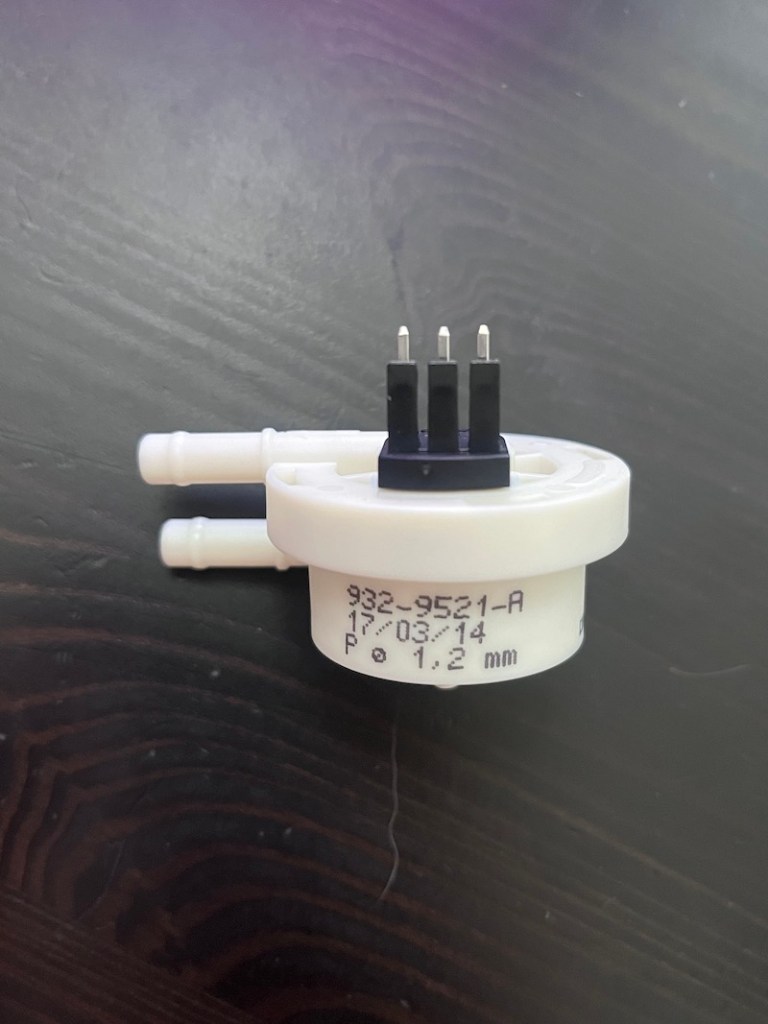
It’s so cute! The three pins told me it’s a Hall-effect sensor, with a little spinny bit and a magnet inside. And it didn’t seem user-serviceable, so a little searching revealed that this is actually a jellybean part that is in all sorts of machinery, comes in multiple variants and is available on eBay as a spare part for several brands of coffeemaker.
Mine didn’t seem to do anything when water flowed through the inlet, like it was stuck open. Theory: the logic board, getting no pulses from the meter, probably cuts off the pump after a timeout period to avoid burning it out, and similarly throttles down the thermoblock to prevent overheating. (Maybe? I’m purely guessing here.)
Oh, and the flow meter is actually totally field-serviceable. I didn’t even think to try this until I got the replacement in the mail, but the top and bottom just twist apart, revealing its one moving piece – a water wheel with magnets, forming the element of a Hall-effect sensor.
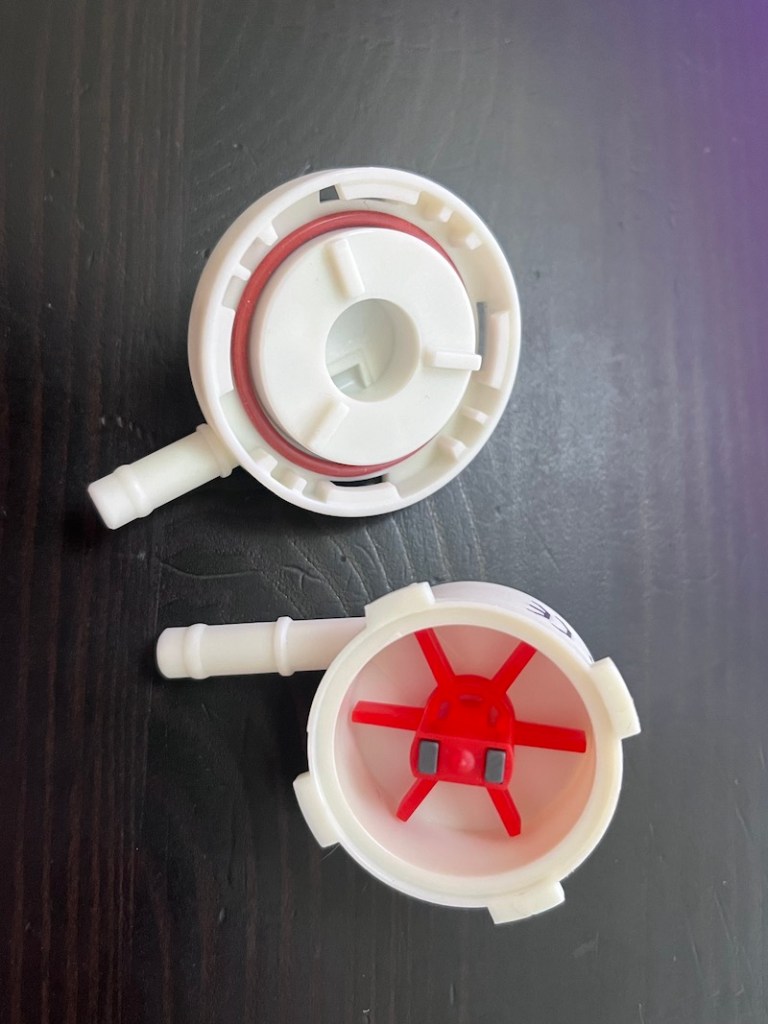
I think mine just got a little debris in the spindle and stopped freely spinning. I installed the new one, but I kept the original as a spare – you never know, right?
So now I have easy coffee again. Just thought I’d share, since nowhere I looked (including iFixit, Reddit, even a gray-market copy of the internal Nespresso service manual) talked about the flowmeter or this failure condition – and this is exactly the kind of little around-the-house fix-it thing that I love to do and I wanted to send the joy of it out to you all.

 Reality-Based Product Management